Saturday, April 25, 2020

New Azure Developer AZ-204 Exam Questions Replacement of AZ-203 Test

The AZ-204 exam is new released and replace the AZ-203 Developing Solutions for Microsoft Azure exam which will be retired on August.Once a candidate passes either the AZ-203 or AZ-204 exam they will earn the Microsoft Certified: Azure Developer Associate certification. PassQuestion provides the latest Azure Developer AZ-204 Exam Questions which cover all the exam topics and objectives and will prepare you for success quickly and efficiently. We regularly update the AZ-204 questions and answers to make sure you always gain access to the most current product.
AZ-204 Exam Description - Developing Solutions for Microsoft Azure

The new AZ-204 beta exam is the ideal choice for any individual aspiring to become a cloud developer on Azure. The AZ-204 exam is suitable for candidates who want to participate in all stages of development, starting from requirements definition. Candidates for this exam also have to contribute to the design, development, deployment, and maintenance of solutions on Microsoft Azure. 
The AZ-204 Developing Solutions for Microsoft Azure certification exam tests and validates your expertise as an Azure Developer. This exam tests your expertise across all phases of the Microsoft Azure development process; from solution design, to development and deployment, to testing and maintenance.

AZ-204 Exam Skill Measured

Develop Azure compute solutions (25-30%)
Develop for Azure storage (10-15%)
Implement Azure security (15-20%)
Monitor, troubleshoot, and optimize Azure solutions (10-15%)
Connect to and consume Azure services and third-party services (25-30%)

View Developing Solutions for Microsoft Azure AZ-204 Free Questions

1.Note: This question is part of a series of questions that present the same scenario. Each question in the series contains a unique solution that might meet the stated goals. Some question sets might have more than one correct solution, while others might not have a correct solution.
After you answer a question in this section, you will NOT be able to return to it. As a result, these questions will not appear in the review screen.
You develop a software as a service (SaaS) offering to manage photographs. Users upload photos to a web service which then stores the photos in Azure Storage Blob storage. The storage account type is General-purpose V2.
When photos are uploaded, they must be processed to produce and save a mobile-friendly version of the image. The process to produce a mobile-friendly version of the image must start in less than one minute.
You need to design the process that starts the photo processing.
Solution: Convert the Azure Storage account to a BlockBlobStorage storage account.
Does the solution meet the goal?

A. Yes
B. No
Answer: B
2.You are developing an application that uses Azure Blob storage.
The application must read the transaction logs of all the changes that occur to the blobs and the blob metadata in the storage account for auditing purposes. The changes must be in the order in which they occurred, include only create, update, delete, and copy operations and be retained for compliance reasons.
You need to process the transaction logs asynchronously.
What should you do?

A. Process all Azure Blob storage events by using Azure Event Grid with a subscriber Azure Function app.
B. Enable the change feed on the storage account and process all changes for available events.
C. Process all Azure Storage Analytics logs for successful blob events.
D. Use the Azure Monitor HTTP Data Collector API and scan the request body for successful blob events.
Answer: B
3.You are developing a web app that is protected by Azure Web Application Firewall (WAF). All traffic to the web app is routed through an Azure Application Gateway instance that is used by multiple web apps. The web app address is contoso.azurewebsites.net.
All traffic must be secured with SSL. The Azure Application Gateway instance is used by multiple web apps.
You need to configure the Azure Application Gateway for the app.
Which two actions should you perform? Each correct answer presents part of the solution.
NOTE: Each correct selection is worth one point.

A. In the Azure Application Gateway’s HTTP setting, enable the Use for App service setting.
B. Convert the web app to run in an Azure App service environment (ASE).
C. Add an authentication certificate for contoso.azurewebsites.net to the Azure Application gateway.
D. In the Azure Application Gateway’s HTTP setting, set the value of the Override backend path option to contoso22.azurewebsites.net.
Answer: AD
4.You need to store the user agreements.
Where should you store the agreement after it is completed?

A. Azure Storage queue
B. Azure Event Hub
C. Azure Service Bus topic
D. Azure Event Grid topic
Answer: B
5.You develop Azure solutions.
You must connect to a No-SQL globally-distributed database by using the .NET API.
You need to create an object to configure and execute requests in the database.
Which code segment should you use?

A. new Container(EndpointUri, PrimaryKey);
B. new Database(Endpoint, PrimaryKey);
C. new CosmosClient(EndpointUri, PrimaryKey);
Answer: C

Tuesday, April 21, 2020

HPE0-V14 Dumps - Building HPE Hybrid IT Solutions

HPE0-V14 Building HPE Hybrid IT Solutions exam is available at PassQuestion. PassQuestion provides you the highest quality HPE ATP HPE0-V14 Dumps which will help you pass your exam successfully. PassQuestion will also help you well consolidate the related IT professional knowledge to let you have a good preparation for your first time to participate in HPE ATP - Hybrid IT Solutions V2 HPE0-V14 Exam.

HPE0-V14 Exam Description - Building HPE Hybrid IT Solutions

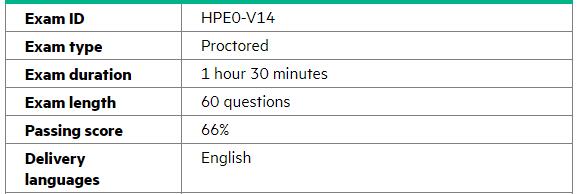
This ATP certification validates a successful candidate has foundational knowledge and skills of the HPE infrastructure strategy, encompassing SMB server, storage, networking, and management tools and their underlying architecture technologies. Given a set of customer requirements and a solution design, implement the solution.

Ideal Candidate For This Exam

The ideal candidate has a minimum of twelve months hands-on experience or equivalent in at least one of the core HPE areas (Server, Storage, and Networking) and six months experience or equivalent in other HPE SMB solutions and foundational technologies.
The candidate assists with the design and participates in the demonstration/proof of concept, integration, and administration aspects of foundational HPE solutions.

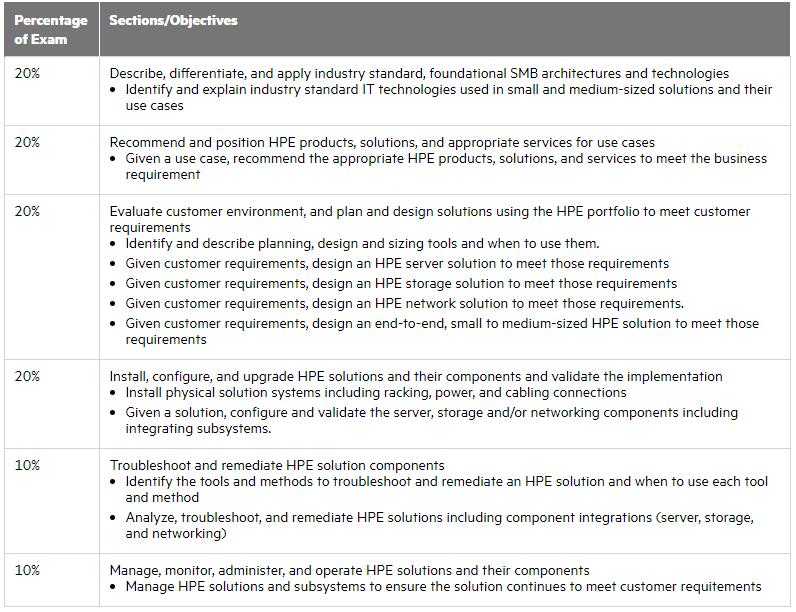
HPE ATP - Hybrid IT Solutions V2 HPE0-V14 Exam Topics


View HPE0-V14 Free Questions From PassQuestion HPE ATP HPE0-V14 Dumps

1.A security client needs a surveillance solution to support 239 Cameras. They expect to generate 2PB of data and require a 10Gb network infrastructure in a single rack.
Which solution should you recommend to meet the customer requirements?

A. HPE Moonshot
B. HPE MSA
C. HPE Apollo Servers
D. HPE SimplVity 380
Answer: C
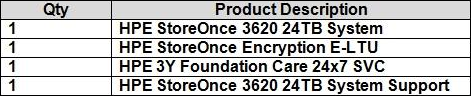
2.Refer to the exhibit.
A customer has been using VEEAM and the HPE StoreOnce 3620 shown in the exhibit to backup their environment. The customer’s legal team has asked to double their retention times for all backup sets, and they are starting to run out of space on the StoreOnce.
Which options could you recommend that the customer add to their existing configuration to accommodate the new requirement? (Select two. Each option represents a separate solution.)

A. HPE StoreOnce Cloud Bank Storage
B. HPE StoreOnce 3620 24TB Capacity Upgrade Kit
C. HPE StoreOnce Gen4 16Gb Fibre Channel Network Card
D. HPE StoreOnce Gen4 10/25Gb SFP Network card
E. HPE D3710 Storage Enclosure
Answer: BD
3.A customer needs NFS access on a fiber channel array.
What must be included in the solution to meet this requirement?

A. StoreEver
B. Storage File Controller
C. Smart Array Controller 
D. StoreOnce RMC
Answer: B
4.What is the correct cable type to use when connecting a pair of switches using Long Range (LR) Transceivers?
A. Direct Attach Cable (DAC)
B. Twin-Ax
C. Single Mode Fiber
D. Multi-mode Fiber
Answer: C
5.When is it appropriate for a customer to implement HPE OneView Standard?
A. To manage multiple servers
B. To monitor their services
C. To enable the Advanced iLO license
D. To update firmware
Answer: B
6.You are creating a configuration for a new Nimble HF40 array.
Which tool should you use to ensure that you include adequate cache in the configuration?

A. HPE NinjaSTARS
B. HPE Storage Sizer
C. HPE OneView
D. HPE SPOCK
Answer: A

MCPA-Level 1 MuleSoft Certified Platform Architect - Level 1 Exam Questions

Want to pass MuleSoft Certified Platform Architect - Level 1 Exam? PassQuestions new updated MCPA-Level 1 MuleSoft Certified Platform Architect - Level 1 Exam Questions which include the latest and most accurate information about MuleSoft Certified Platform Architect - Level 1 exam.It ensure you have a good preparation for your exam and help you pass your MCPA-Level 1 certification exam successfully in your first attempt.

What Is MuleSoft Certified Platform Architect - Level 1?

The MuleSoft Certified Platform Architect - Level 1 exam validates that an architect has the required knowledge and skills to direct the emergence of an effective application network out of individual integration solutions following API-led connectivity across an organization using Anypoint Platform. S/he should be able to:
  • Optimize and shape the Anypoint Platform deployment in the specific organizational context, working with business, infrastructure, InfoSec, and other teams.
  • Define how Anypoint Platform is used in conjunction with other tools and applications in the organization.
  • Define the usage of Anypoint Platform and the corresponding organizational and process changes needed to help the Platform be sustainable.
  • Provide guidance and drive creation of standards, reusable assets, and automation required for scale and multi-LOB adoption.

MuleSoft Certified Platform Architect - Level 1 Exam Overview

Format: Multiple-choice, closed book, proctored online or in a testing center
Length: 58 questions
Duration: 120 minutes (2 hours)
Pass score: 70%
Language: English
Cost: $375
The exam can be taken a maximum of 5 times, with a 24 hour wait between each attempt.

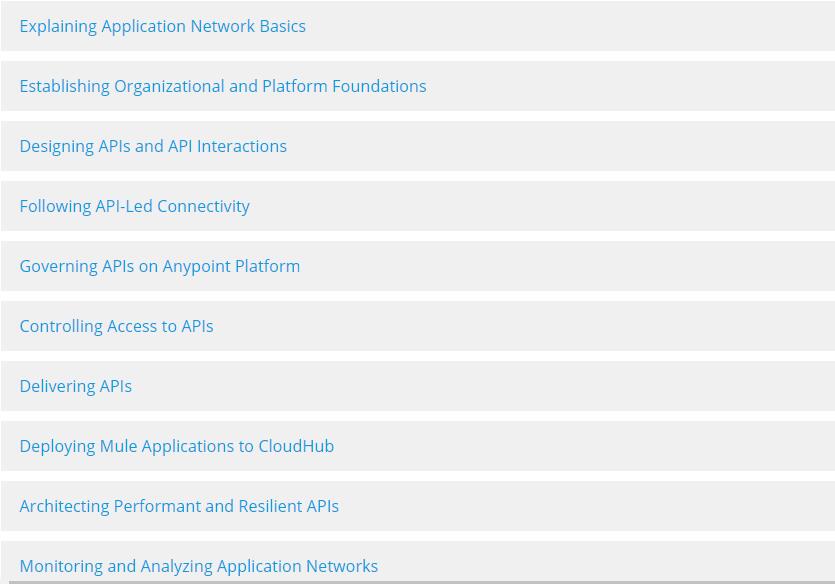
MuleSoft Certified Platform Architect - Level 1 Exam Topics

The exam validates that the candidate can perform the following tasks.


View Online MuleSoft Certified Platform Architect - Level 1 Free Questions

1.What API policy would LEAST likely be applied to a Process API?
A. Custom circuit breaker
B. Client ID enforcement
C. Rate limiting
D. JSON threat protection
Answer: A
2.What is a key performance indicator (KPI) that measures the success of a typical C4E that is immediately apparent in responses from the Anypoint Platform APIs?
A. The number of production outage incidents reported in the last 24 hours
B. The number of API implementations that have a publicly accessible HTTP endpoint and are being managed by Anypoint Platform
C. The fraction of API implementations deployed manually relative to those deployed using a CI/CD tool
D. The number of API specifications in RAML or OAS format published to Anypoint Exchange
Answer: B
3.An organization is implementing a Quote of the Day API that caches today's quote.
What scenario can use the CloudHub Object Store via the Object Store connector to persist the cache's state?

A. When there are three CloudHub deployments of the API implementation to three separate CloudHub regions that must share the cache state.
B. When there are two CloudHub deployments of the API implementation by two Anypoint Platform business groups to the same CloudHub region that must share the cache state.
C. When there is one deployment of the API implementation to CloudHub and another deployment to a customer-hosted Mule runtime that must share the cache state.
D. When there is one CloudHub deployment of the API implementation to three CloudHub workers that must share the cache state.
Answer: C
4.What condition requires using a CloudHub Dedicated Load Balancer?
A. When cross-region load balancing is required between separate deployments of the same Mule application
B. When custom DNS names are required for API implementations deployed to customer-hosted Mule runtimes
C. When API invocations across multiple CloudHub workers must be load balanced
D. When server-side load-balanced TLS mutual authentication is required between API implementations and API clients
Answer: B
5.What do the API invocation metrics provided by Anypoint Platform provide?
A. ROI metrics from APIs that can be directly shared with business users
B. Measurements of the effectiveness of the application network based on the level of reuse
C. Data on past API invocations to help identify anomalies and usage patterns across various APIs
D. Proactive identification of likely future policy violations that exceed a given threat threshold
Answer: C
6.What is true about the technology architecture of Anypoint VPCs?
A. The private IP address range of an Anypoint VPC is automatically chosen by CloudHub.
B. Traffic between Mule applications deployed to an Anypoint VPC and on-premises systems can stay within a private network.
C. Each CloudHub environment requires a separate Anypoint VPC.
D. VPC peering can be used to link the underlying AWS VPC to an on-premises (non AWS) private network.
Answer: B

Friday, April 3, 2020

Updated DELL EMC ISM V4 DEA-1TT4 Real Exam Questions

DEA-1TT4 Associate - Information Storage and Management Version 4 Exam is a qualifying exam for the Associate - Information Storage and Management (DCA-ISM) certification.To keep pace with real DEA-1TT4 ISM V4 Exam, PassQuestion new updated DELL EMC ISM V4 DEA-1TT4 Real Exam Questions. It is the latest version for ensuring that you can pass EMC DEA-1TT4 exam in the first try. So we highly recommend that if you are preparing for your DEA-1TT4 exam, please choose our real EMC ISM V4 DEA-1TT4 questions online to study.

DEA-1TT4 Associate - Information Storageand Management Version 4 Exam Overview

DEA-1TT4 exam focuses on information storage and management in a data center. It includes third platform technologies, intelligent storage systems, software-defined storage, storage networking technologies, and various business continuity options– along with security and management of a storage infrastructure. A limited number of questions refer to product examples that are used in the training to reinforce the knowledge of technologies and concepts.

DELL EMC ISM V4 DEA-1TT4 Exam Topics Covered In The DEA-1TT4 Real Test

Modern Data Center Infrastructure (15%)
• Describe the data classification, elements of a data center, key characteristics of a data center, and key technologies driving digital transformation 
• Explain the cloud characteristics, cloud service models, and cloud deployment models
• Explain the key characteristics of big data, components of a big data analytics solution, Internet of Things (IoT), machine learning, and artificial intelligence (AI)
• Describe the building blocks of a modern data center
• Describe a compute system, storage, connectivity in a data center, application, and options to build a modern data center
Storage Networking Technologies (20%)
• Describe Storage Area Network (SAN), FC architecture, FC topologies, zoning, and virtualization in FC SAN
• Describe TCP/IP, IP SAN, iSCSI protocol, components, connectivity, addressing, discovery domains, and VLAN
• Explain the components and connectivities of FCIP and FCoE
Storage Systems (26%)
• Explain the components of an intelligent storage system, RAID, erasure coding, data access methods, scale-up and scale-out architectures
• Explain the components of block-based storage system, storage provisioning, and storage tiering mechanisms
• Explain the NAS components and architecture, NAS file sharing methods,  and file-level virtualization and tiering
• Describe object-based storage device components, functions, operations, and unified storage architecture
• Describe software-defined storage attributes, architecture, functions of the control plane, software-defined extensibility, and software-defined networking functionalities
Backup, Archive, and Replication (24%)
• Describe the information availability measurements and key fault tolerance techniques
• Explain backup granularity, architecture, backup targets, operations, and backup methods
• Describe data deduplication and data archiving solutions architecture
• Describe replication uses, and replication and migration techniques
Security and Management (16%)
• Describe the information security goals, terminologies, various security domains, and threats to a storage infrastructure
• Explain key security controls to protect the storage infrastructure
• Describe the storage infrastructure management functions and processes

View DELL EMC ISM V4 DEA-1TT4 Free Questions Online Before Ordering PassQuestion Real DEA-1TT4 Exam Questions

1.What is an accurate statement about Governance?
A. Restrict access to certain users
B. Ensure removal of security risks
C. Authorize policy-making decisions
D. Demonstrate adherence to polices
Answer: C
2.A company is using an intrusion detection and prevention system (IDPS) to scan and analyze intrusion events.
Which IDPS technique uses a database that contains known attack patterns?

A. Role-based
B. Profile-based
C. Signature-based
D. Anomaly-based
Answer: C
3.An Ethernet switch has eight ports and all ports must be operational for 24 hours, from Monday through Friday.
However, a failure of Port4 occurs as follows:
• Monday = 8 PM to 9 PM
• Wednesday 7 PM to 9 PM
• Thursday = 6 AM to 9 AM
• Saturday = 4 PM to 7 PM
What is the MTTR of Port 4?

A. 2 hours
B. 3 hours
C. 28 hours
D. 38 hours
Answer: A
4.What accurately describes an iSCSI HBA?
A. Performs both iSCSI and TCP/IP processing
B. Requires CPU cycles for TCP/IP processing
C. Requires a software adapter with built-in functionality
D. Enables transmission of data through iSCSI tunneling
Answer: A
5.When using the erasure coding technique in an object-based storage system, data is divided into 12 data segments and 4 coding segments.
What is the maximum number of disk drive failures against which data is protected by the configuration?

A. 3
B. 4
C. 8
D. 12
Answer: A
6.What is a key advantage of cloning a virtual machine (VM)?
A. Ability to run new VMs simultaneously with the same IP address.
B. Reduces the time required to create multiple copies of a VM.
C. Improves the performance of an existing VM and new VMs.
D. Eliminates the need to create multiple snapshots for a VM.
Answer: B

ACMA v8.4 HPE6-A70 Real Exam Questions

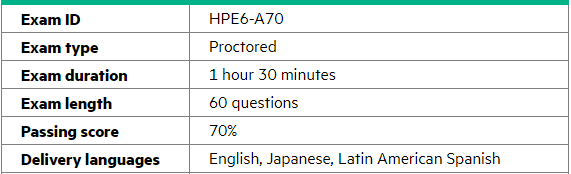
HPE6-A70 Aruba Certified Mobility Associate Exam is for ACMA v8.4 Certification, we have candidates passed this ACMA HPE6-A70 exam with a score of 96% on Mar.06.2020,so you can feel easy to study our PassQuestion HPE6-A70 Real Exam Questions for your preparation. All these 60 questions in HPE6-A70 Real Exam Questions are collected from real test, which can ensure you pass your ACMA v8.4 Certification HPE6-A70 exam successfully.

HPE6-A70 Aruba Certified Mobility Associate Exam Description

The Aruba Certified Mobility Associate Exam tests your knowledge and skills to deploy AOS 8 single-site, on premise, geographically simple enterprise WLANs. Typical candidates for this certification are networking IT professionals who deploy small-to-medium scale network solutions based on Aruba products and technologies.


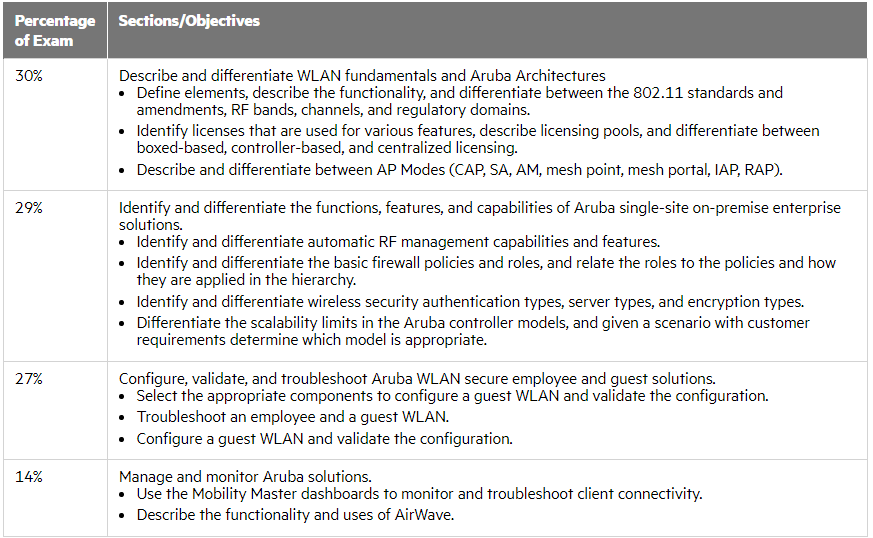
HPE6-A70 Exam Objectives Tested for ACMA v8.4 Certification


View HPE6-A70 Sample Questions Collected From PassQuestion HPE6-A70 Real Exam Questions

1.A network administrator creates the role employees and adds this rule to it:
user any any permit
The first several wireless clients assigned to the employees role are assigned IP addresses in the 10.10.10.0/24 subnet. Several other wireless clients with the employees role are then assigned IP addresses in the 10.10.20.0/24.
When the Aruba firewall matches traffic from these clients to the user any any permit rule, what does it do?

A. It permits traffic from wireless clients in both the 10.10.10.0/24 and 10.10.20.0/24 subnet as long as the packet has a source IP.
B. It permits the traffic from wireless clients in the 10.10.20.0/24 subnet, but drops the traffic from wireless clients in the 10.10.10.0/24 subnet.
C. It drops traffic from wireless clients in both the 10.10.10.0/24 and 10.10.20.0/24 subnet.
D. It permits the traffic from wireless clients in the 10.10.10.0/24 subnet, but drops the traffic from wireless clients in the 10.10.20.0/24 subnet.
Answer: A
2.A company has many 7220 controllers in its Aruba wireless architecture. A network administrator wants to use the Traffic Analysis dashboard in order to monitor which type of applications are being used by wireless users.
What is required for this implementation?

A. AirMatch and ClientMatch must be enabled.
B. The solution must have active PEFNG licenses.
C. WLANs must use the decrypt-tunnel forwarding option.
D. Firewall policies must include application filtering rules.
Answer: B
3.A network administrator configures an Aruba Mobility Master (MM)-based solution to provide wireless access to employees. 
The solution must meet these criteria:
- Authenticate users to a network RADIUS server
- Enforce different Aruba firewall rules based on the user department
How can the administrator meet these criteria in the simplest way?

A. Create a different WLAN and SSID for each department. Apply different firewall policies to each WLAN.
B. Have the RADIUS server send different roles for users in different departments. Apply role-based firewall policies.
C. Create multiple zones on the MM. Assign different departments are sets of firewall policies to different zones.
D. Have the RADIUS server assign users in different departments to different VLANs. Apply firewall policies based on IP ranges.
Answer: B
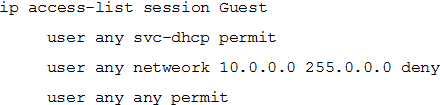
4.Users to which this policy apply are unable to receive IP addresses with DHCP.
How should the administrator fix the issue?
A. Move the user any svc-dhcp permitrule to the bottom of the list.
B. Remove the deny rule from the policy.
C. Use the correct service alias in the user any svc-dhcp permitrule.
D. Change user to any in the user any svc-dhcp permitrule.
Answer: C
5.An Aruba solution runs ArubaOS 8 and uses a mobility master architecture.
Which feature can network administrators use to balance wireless across APs on different channels?

A. AppRF
B. ARM
C. Client Match
D. AirMatch
Answer: C
6.What is the difference between how a network administrator can monitor clients in the Mobility (MM) interface and in the AirWave Management Platform?
A. AirWave shows trends for the past several minutes, while MM shows longer trends.
B. AirWave combines information from more sources, such as RADIUS authenticating servers and APs.
C. AirWave shows the current signal level for the client connection, while MM does not show RF statistics.
D. MM shows user and role information associated with clients, while AirWave does not.
Answer: B

Friday, March 27, 2020

CCNP Security Core 350-701 SCOR Exam Questions

If you plan to get CCNP and CCIE Security Certification, 350-701 SCOR Implementing and Operating Cisco Security Core Technologies v1.0 exam is one of the required exams,then you can choose Concentration exams to fulfill your certification. Now PassQuestion new released CCNP and CCIE Security Core 350-701 SCOR Exam Questions to help you get well prepared, all test questions are covered to help you pass your 350-701 exam successfully.

350-701 SCOR Exam Description - Implementing and Operating Cisco Security Core Technologies v1.0

The Implementing and Operating Cisco Security Core Technologies v1.0 (SCOR 350-701) exam is a 120-minute exam associated with the CCNP Security, Cisco Certified Specialist - Security Core, and CCIE Security certifications. This exam tests a candidate's knowledge of implementing and operating core security technologies including network security, cloud security, content security, endpoint protection and detection, secure network access, visibility and enforcements. 

What Topics Will Be Covered In The 350-701 SCOR Exam?

Network security
Cloud security
Content security
Endpoint protection and detection
Secure network access
Visibility and enforcement

View 350-701 Free Questions Which Are Part Of PassQuestion 350-701 Real Exam Questions

1.Which feature requires a network discovery policy on the Cisco Firepower Next Generation Intrusion Prevention System?
A. security intelligence
B. impact flags
C. health monitoring
D. URL filtering
Answer: A
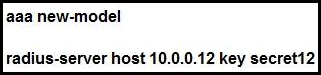
2.Refer to the exhibit.
Which statement about the authentication protocol used in the configuration is true?
A. The authentication request contains only a password
B. The authentication request contains only a username
C. The authentication and authorization requests are grouped in a single packet.
D. There are separate authentication and authorization request packets.
Answer: C
3.Which two preventive measures are used to control cross-site scripting? (Choose two.)
A. Enable client-side scripts on a per-domain basis.
B. Incorporate contextual output encoding/escaping.
C. Disable cookie inspection in the HTML inspection engine.
D. Run untrusted HTML input through an HTML sanitization engine.
E. SameSite cookie attribute should not be used.
Answer: AB
4.Which policy is used to capture host information on the Cisco Firepower Next Generation Intrusion Prevention System?
A. correlation
B. intrusion
C. access control
D. network discovery
Answer: D
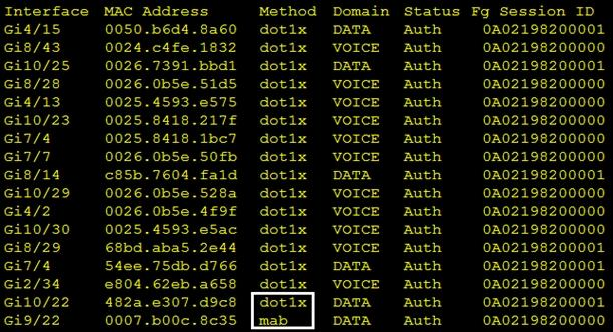
5.Refer to the exhibit.
Which command was used to generate this output and to show which ports are authenticating with dot1x or mab?
A. show authentication registrations
B. show authentication method
C. show dot1x all
D. show authentication sessions
Answer: B
6.An engineer is configuring a Cisco ESA and wants to control whether to accept or reject email messages to a recipient address.
Which list contains the allowed recipient addresses?

A. SAT
B. BAT
C. HAT
D. RAT
Answer: D
7.Which two capabilities does TAXII support? (Choose two.)
A. exchange
B. pull messaging
C. binding
D. correlation
E. mitigating
Answer: BC


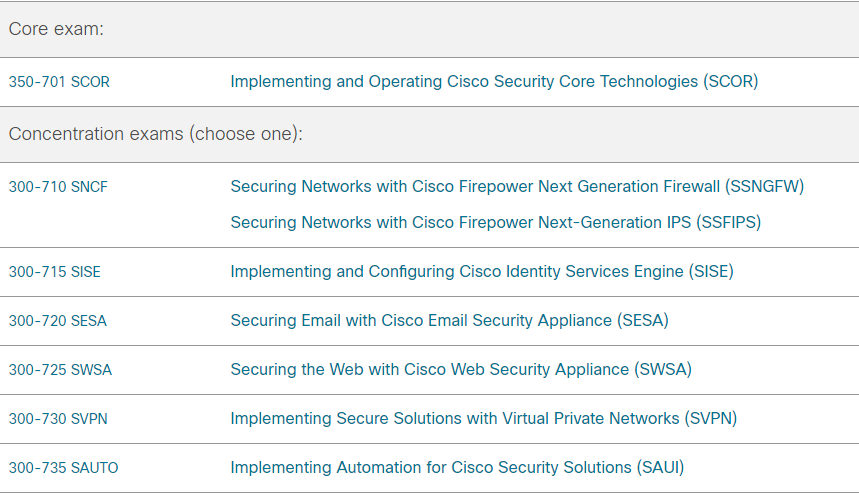
Requirements For CCNP Security Certification

To earn CCNP Security, you pass two exams: a core exam and a security concentration exam of your choice. And now every exam in the CCNP Security program earns an individual Specialist certification, so you get recognized for your accomplishments along the way.
The core exam focuses on your knowledge of security infrastructure. The core exam is also the qualifying exam for CCIE Security certification. Passing this exam helps toward earning both of these certifications.
Concentration exams focus on emerging and industry-specific topics. You can prepare for concentration exams by taking their corresponding Cisco training courses.

New 200-901 DEVASC Exam Questions

200-901 DEVASC is a new Cisco exam related to Cisco Certified DevNet Associate certification which was released on Feb.24.2020, if you are looking for the preparation for this new Cisco 200-901 DEVASC exam. PassQuestion is here to help you. You will get New 200-901 DEVASC Exam Questions which contains 102 questions and answers to practice, after studying, you will feel easy to write your exam and pass 200-901 DevNet Associate Exam v1.0 exam successfully.

200-901 DEVASC Exam Description - Cisco Certified DevNet Associate

Achieving Cisco Certified DevNet Associate certification proves your skills in developing and maintaining applications built on Cisco platforms. To earn DevNet Associate certification, you pass one exam that covers the fundamentals of software development and design for Cisco platforms.
DevNet Associate Exam v1.0 (DEVASC 200-901) exam is a 120-minute exam associated with the Cisco Certified DevNet Associate certification. This exam tests a candidate's knowledge of software development and design including understanding and using APIs, Cisco platforms and development, application development and security, and infrastructure and automation.

200-901 DEVASC Exam Topics In The 200-901 DevNet Associate Exam v1.0

This exam tests your knowledge of software development and design, including:
Understanding and using APIs
Cisco platforms and development
Application development and security
Infrastructure and automation

View 200-901 DEVASC Free Questions Online Before Buying PassQuestion Complete 200-901 DEVASC Real Exam Questions

1.Which two statements describe the advantages of using a version control system? (Choose two.)
A. It allows for branching and merging so that different tasks are worked on in isolation before they are merged into a feature or master branch.
B. It provides tooling to automate application builds and infrastructure provisioning.
C. It allows multiple engineers to work against the same code and configuration files and mange differences and conflicts.
D. It provides a system to track User Stories and allocate to backlogs.
E. It allows developers to write effective unit tests.
Answer: AD
2.On which port does NETCONF operate by default?
A. 23
B. 443
C. 822
D. 830
Answer: D
3.Which product provides network controller-level management features?
A. Cisco ISE
B. Cisco DNA Center
C. Cisco UCS Manager
D. Cisco NX-OS
Answer: B
4.Refer to the exhibit.
 
A process on the host wants to access the service running inside this Docker container.

Which port is used to make a connection?
A. only outbound connections between 3000 and 5000 are possible
B. port 3000
C. any port between 3000 and 5000
D. port 5000
Answer: C
5.Which description of a default gateway is true?
A. It is a security feature that denies certain traffic.
B. It is a device that receives IP packets that have no explicit next-hop in the routing table.
C. It is a feature that translates between public and private addresses.
D. It is a device that receives Layer 2 frames with an unknown destination address.
Answer: B
6.Which two statements are true about Cisco UCS Manager, Cisco UCS Director, or Cisco Intersight APIs? (Choose two.)
A. UCS Manager uses JSON to encode API interactions and utilizes Base64-encoded credentials in the HTTP header for authentication.
B. UCS Director API interactions can be XML- or JSON-encoded and require an API key in the HTTP header for authentication.
C. Cisco Intersight uses XML to encode API interactions and requires an API key pair for authentication.
D. UCS Manager API interactions are XML-encoded and require a cookie in the method for authentication.
E. Cisco Intersight API interactions can be encoded in XML or JSON and require an API key in the HTTP header for authentication.
Answer: BD